Arctic temperature and precipitation extremes in present-day and future storyline-based variable resolution Community Earth System Model simulations
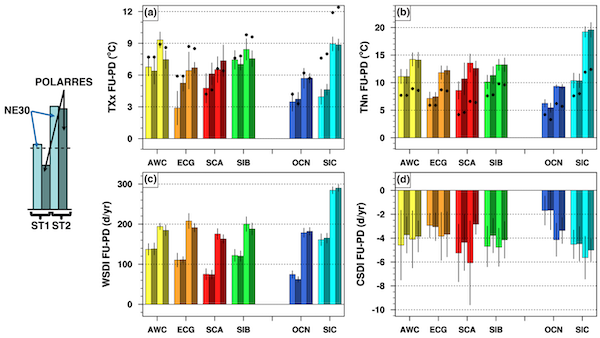
A new modeling study co-authored by Xavier Levine examines how climate extremes in the Arctic may evolve as the region continues to warm faster than the global average. Using the variable-resolution CESM2.2 model, the team compares standard global simulations with high-resolution grids refined over the Arctic to better capture heat waves and heavy precipitation. They find that higher resolution improves the simulation of precipitation extremes, while temperature extremes are better represented in coarser global runs. Projections for the end of the century show stronger and longer-lasting heat extremes, fewer cold extremes, and more intense and frequent heavy precipitation, particularly in regions affected by sea-ice loss and ocean warming.