Porous Cavities and Smooth Boundaries: Brinkman Volume Penalization for Ice-Shelf-Ocean Interactions in Earth System Models
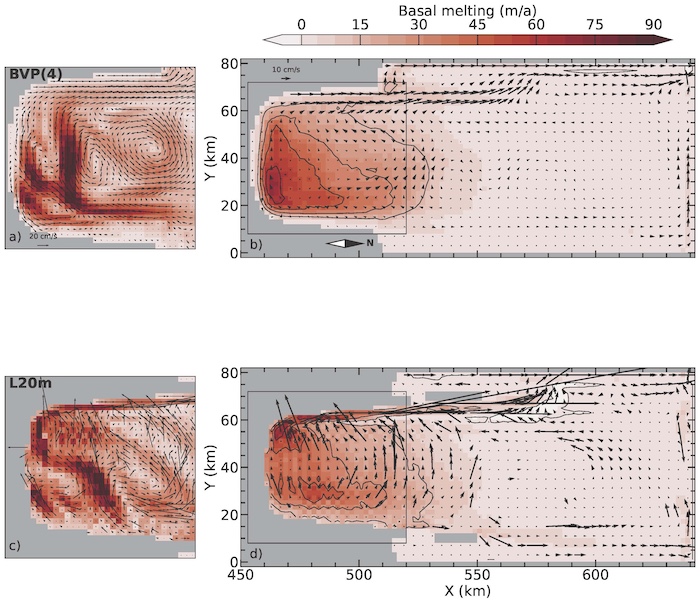
A recent study led by Antoine Nasser investigates new ways to improve the simulation of ice–shelf–ocean interactions in numerical ocean models. Using an idealized ISOMIP+ configuration, the team shows the benefit of the Brinkman Volume Penalization (BVP) approach in mitigating spurious noise in basal melt rates and excessive mixing, which are recurring issues when ice-shelf cavities are represented in z-coordinate models. The BVP method treats the ice–ocean interface as a porous region, where smoothing acts as an effective increase in vertical resolution, producing melt patterns and circulation comparable to terrain-following models, while yielding colder, fresher ice-shelf waters and a stronger overturning circulation. These results highlight the potential of the BVP approach to improve the representation of ice-shelves in ocean models, paving the way toward a better understanding of Antarctic ice-sheet melting.