Design and Implementation of a Data-Driven Parameterization for Mesoscale Eddy-Induced Transport: Idealized Two-Layer Configurations
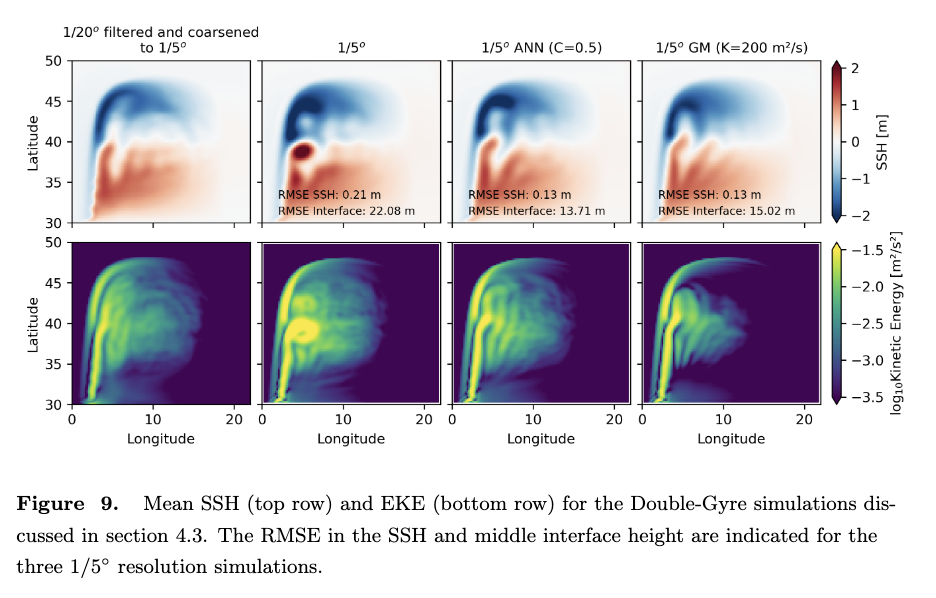
Mesoscale eddies, the ocean’s swirling currents, move heat and tracers and drain potential energy from the large-scale circulation. Most climate models can’t fully resolve them, so their effects are approximated with the Gent-McWilliams (GM) scheme. GM captures the overall energy removal but assumes eddy fluxes always run down the gradient, missing the up-gradient and cross-gradient fluxes seen in reality. It can also dampen eddies that models partially resolve.
In new M²LInES work led by Dhruv Balwada, the team developed a machine learning parameterization free of this diffusive constraint. Using a small, inexpensive neural network, it captures the full structure of eddy thickness fluxes while still extracting energy, adapts to both the flow and model resolution, and is tuned with a single simple parameter. Implemented in NOAA GFDL’s MOM6 ocean model, it performed well in idealized channel and gyre simulations at eddy-permitting and coarse resolutions.